

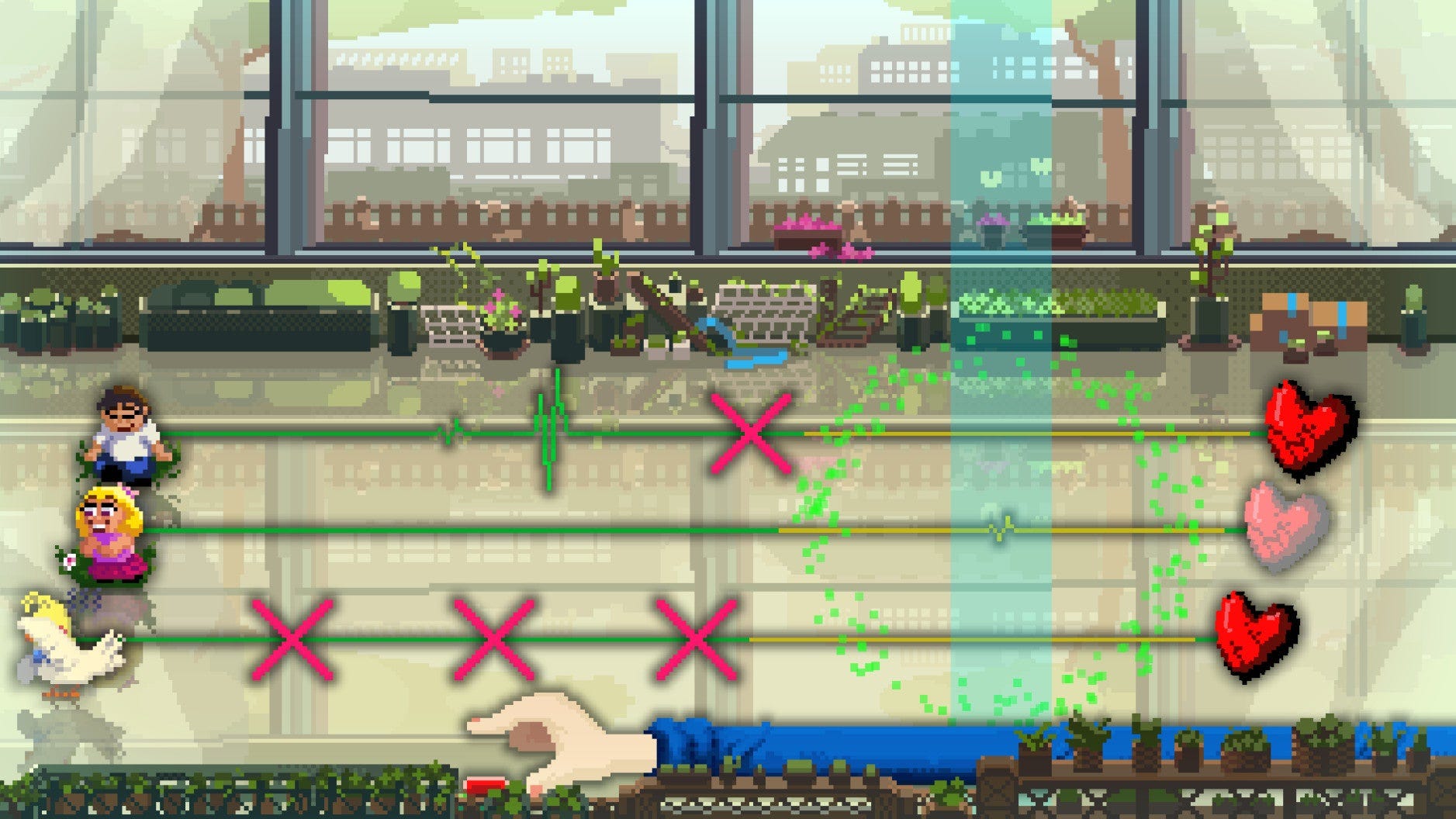
I recently finished my playthrough of Rhythm Doctor’s story mode. It was quite the departure from my previous conceptions of what a rhythm game is. First of all, it was the only rhythm game I’ve ever played to have an overarching narrative driven by dialogue and cutscenes. Second, its gameplay felt much more intertwined with the music than other beat games; in Osu!, you might use the music to help time your inputs, but you’re certainly not playing cross-rhythms, claves, and polyrhythms like Rhythm Doctor asks you to. Despite its consistent claim that you just have to “tap on the seventh beat!,” I had to use a surprising amount of musical intuition that I wouldn’t have had if it weren’t for my musical training.
These innovations made Rhythm Doctor feel like a music-driven narrative that you happen to be tapping along to, rather than a rhythm game in the traditional sense. Sure, if you mistime your inputs, you may have to restart the level; but otherwise, the story progresses without you.
In fact, Rhythm Doctor has an ongoing joke that you play as a remote worker who is unable to speak except through the press of the spacebar. Despite seeming like a throwaway joke, this inability to make choices that control the story cements this game as a narrative that you watch rather than shape—like a movie, or perhaps more appropriately, like a musical.
What sets apart different genres of music? You might point to instrumentation, tempo, vocal style, or production technique. While these are all aspects that definitely define genres, I’d like to argue that more important than the music itself is the way in which you interact with it.
A baroque concert looks very different than a jazz performance, which looks very different from a DJ set which looks very different from LoFi playing in a coffee shop. Each scenario has its own norms associated with how the audience interacts with the performers. Do you clap along with the tactus? Do you holler when the singer hits a high note or when the rapper recites a particularly creative line? Or do you sit silently in your chair, making sure to hold your applause between movements?
I was first introduced to the framework of musicking by Adam Neely. Coined by Christopher Small in his book of the same name, he posits that music is as much a score or an audio file as it is the way we interact with it. The same song is experienced very differently depending on whether you’re listening to it while studying, hearing it live, or even being the one performing the track.
Evidently, as music technology has evolved over the past centuries, decades, and years, the ways in which we can “music” have exploded in number. The phonograph allowed people to music at home. The first headphones allowed people to music without others. And Spotify allowed people to music to millions of songs without needing to buy them first.
I believe rhythm games to be one of our newest ways to music. Just like the bassist in a band is musicking in a very different way than the spectator in the front row, someone playing a rhythm game is interacting with a track in a different manner than if they were to simply listen to it. Our human ability to entrain is crucial to music as a whole; rhythm games offer an opportunity to do so in a more official and expected capacity than, say, tapping your foot along to a song.
Even within rhythm games, musicking might look vastly different. My experience playing Rhythm Doctor made me feel like I was a spectator watching a story unfold; on the other hand, more competitive games like Osu! or Beat Saber require deeper concentration and entwinement with the music.
So, whether you’re looking to admire cute visuals while playing music-based minigames or run around a bullet hell while staying on beat, rhythm games might be the next form of musicking that you’ve been looking for.
And hey, since you seem to be a rhythm game fan, why not build your own rhythm games with my latest project, Rhythm Game Studio? :)